

Energy & SustainabilitySK Gas
SK Gas eLNG Information Architecture Consulting
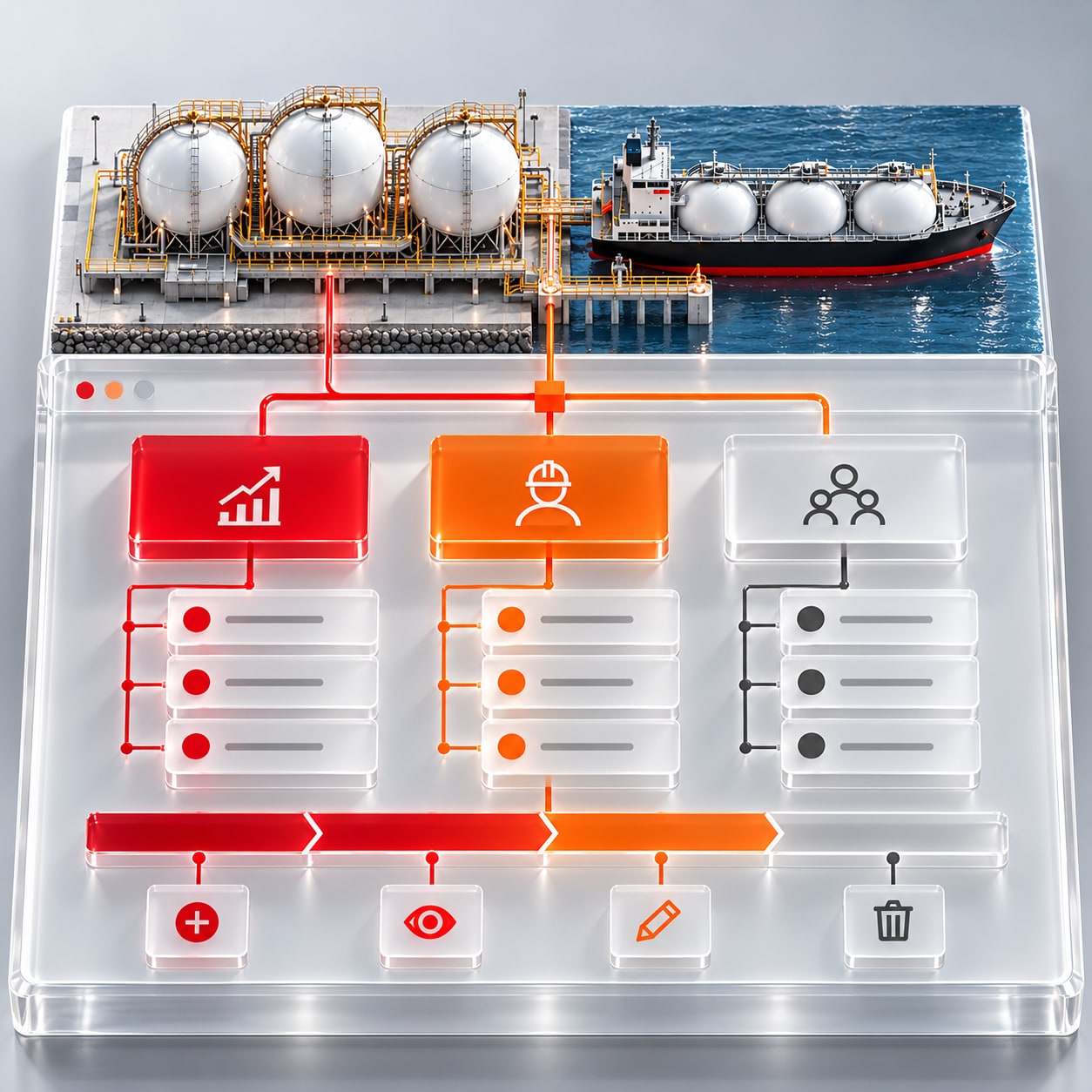

Rebuilding an LNG business system around its value chain and the people who use it.
Project Information
- Industry
- Energy & Sustainability
- Project Type
- Optimization
- Role
- Business Analysis, IA Design, IA Guideline
- Client
- SK Gas
- Client
Introduction - Founded in 1985, SK Gas is Korea’s leading LPG company, expanding from LPG import and distribution into eco-friendly energy such as LNG power generation and hydrogen. Amid rapid change in the energy industry, it aims for global leadership as a “Total Solution Provider” by expanding its existing business, maximizing synergies and creating new growth engines.
The biggest task and mission of this project was to analyze employees’ work status, frequency of use and processing cycles in SK Gas’s B2B-based internal and external work systems, and improve those systems to run smoothly and efficiently.
The hardest part of the project was understanding the special work processes of the energy sector and verifying whether the processes and system screens were seamlessly connected. We spent long hours discussing work processes with the people closest to the work, sometimes in debate, and where processes seemed to need improvement, it became time to reinterpret them together from both sides’ perspectives.
Case Intelligence Summary
Pain Points
We had to verify that LNG’s unique work processes connect smoothly with the system screens.
To improve SK Gas's B2B work system, we first had to understand employees' work, how often they use it and how often tasks cycle. The hardest part was understanding the workflows unique to the LNG energy business and verifying that they connected smoothly to the system's screens. For field staff used to the old way of working, adapting to a new system was a big leap, so narrowing that gap was the challenge. And because the system was already under development, its information structure had to be reviewed both quickly and accurately.
Strategic Lens
We redefined the workflow around the LNG value chain.
We started by understanding how the LNG business and its overall process work, analyzing user roles along the industry value chain. Analyzing the as-is menu tree and program list, we understood unit tasks by permission, classified menu access for every permission level and set a hierarchy of work units. Comparing the menu tree against each screen's storyboard, we found where real workflows and menus diverged, where functions were duplicated, and where one task forced users to jump between several menus. On that basis we redefined the workflow around the LNG value chain so tasks connect without breaks across a timeline-based cycle.
Creative Approach
Behavior scenarios by permission and a journey timeline set the criteria for which menus appear.
Instead of simply listing menus, we designed an information structure where users meet menus according to service scenarios and flow naturally to their next action. Using the workflow as a base, we separated shared tasks from individual tasks for each role and checked where they conflicted or overlapped unnecessarily. We defined activities by permission and set menu-exposure rules on a journey-based timeline. We then proposed three information-structure options by viewpoint — workflow-based, to-do by permission, and a split between work and operations — leading to the best work-screen design.
Delivered Experience
We derived a CRUD-based menu composition guide and a menu activity index.
Going beyond an IA guide, we distributed CRUD-based menu guidelines that could be applied to actual menus right away. Grouping and task priorities that raise efficiency gave the system a consistent, convenient architecture, and analyzing menu hierarchies by permission produced a menu activity index for sequencing work and improving the GNB, LNB and utility levels. We also defined a B2B information-architecture standard based on shared tasks and linked workflows, along with work-access scenarios by permission. In Korean IT projects, where information architecture is often treated as a minor task, diagnosing the IA of a system still in development was a rare case.
Facing a similar challenge?
Contact