

Designing Creativity Beyond Generative AI
2026. 04.23
Generative AI in creative design is evolving beyond outputs. Explore Adobe Firefly insights on workflows, BX and CX strategy, and scalable brand systems.
Saltcake Shares Insights from the Adobe Firefly Webinar: Exploring Applications Beyond Generative AI Features into Design Processes and BX·CX Strategy
“Generative AI is no longer just a tool for producing outputs. Saltcake explored its potential to reshape creative workflows and inform BX and CX strategy through the Adobe Firefly webinar.”
- Saltcake
The digital environment has continuously expanded, with new tools consistently at the center of transformation
However, recent advancements in generative AI go beyond the evolution of production tools. They are moving toward integrating the entire creative flow—from ideation and asset generation to collaboration and brand management—into a unified system. Creativity is now shifting from the question of “what can be created” to “how it can be connected and leveraged.” This shift was clearly demonstrated in the Adobe Firefly Webinar (April 2026). The features introduced were not merely technical updates but signals of a broader evolution—one where generative AI moves from supporting isolated tasks to restructuring entire workflows.
One of the most notable changes lies in the standards of the generative environment. Firefly provides a framework that does not use user content for training and allows for the selective use of multiple AI models. This becomes a critical factor for enterprises handling proprietary design assets and internal projects, enabling the adoption of generative AI in real-world workflows without concerns over security and copyright risks.
Post-generation workflows are also evolving. Traditionally, achieving the desired output required iterative prompt adjustments or additional editing in external tools. With the introduction of the Markup feature, users can directly annotate images or define editable areas with brush-based inputs, enabling generation and editing to occur within a single, continuous flow. This is not just a functional enhancement—it shortens production cycles and significantly improves the accuracy of intent communication.
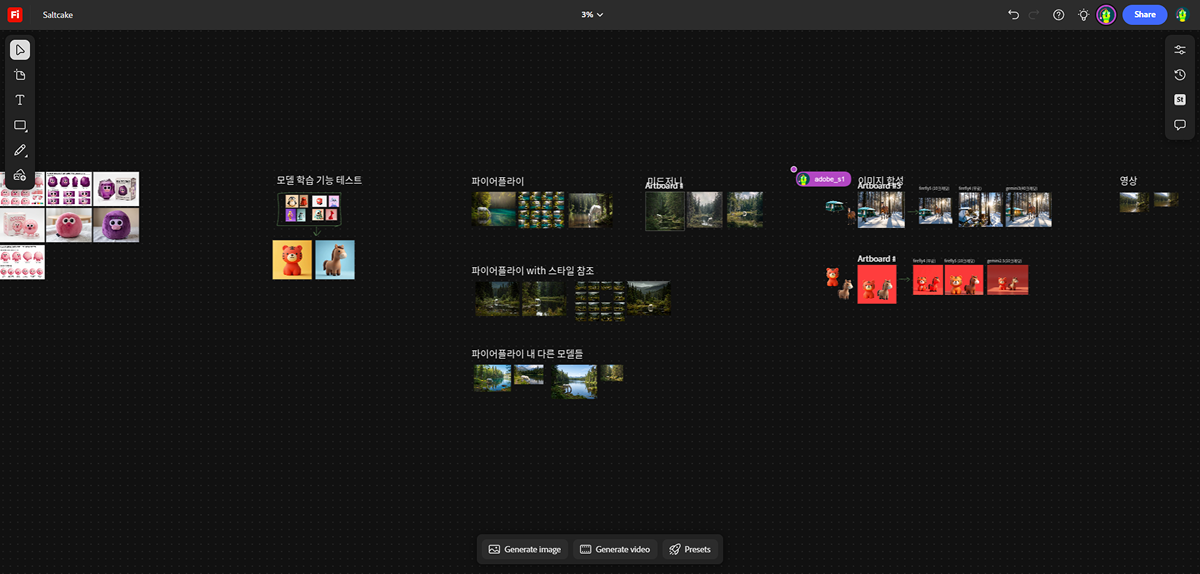
The structure of workflows is becoming increasingly integrated. Firefly Board connects previously fragmented processes—such as reference gathering, ideation, generation, feedback, and refinement—into a single canvas. Tasks that once required switching between tools like Adobe Photoshop, Adobe Illustrator, and Adobe After Effects can now be managed within one environment. This integration is expected to significantly enhance efficiency, particularly in early-stage ideation and promotional creative production.
From a brand perspective, another key innovation is Firefly Custom Models. With a relatively small set of training images, brands can encode their visual identity and generate outputs that maintain a consistent tone and style. This reduces the need for repetitive reference sharing and fundamentally transforms how brand assets are scaled. It is not merely about speed—it is about maintaining consistency in brand experience.
Saltcake has been actively experimenting with applying these capabilities to real-world workflows
By leveraging Firefly Board, the team has been creating various goods and extended visual assets based on its brand character to validate scalability. At the same time, they are testing the integration of generative AI into production processes by combining Markup-based editing with Custom Model training.
Amid these changes, the role of creativity itself is evolving. As AI becomes more advanced, the act of producing outputs will gradually decrease in importance. Instead, defining what to create and designing how it connects to meaningful experiences will become the core competency. AI remains a tool, but structuring how it is utilized within a broader system remains a human responsibility. Beyond understanding features, organizations must be able to design strategic applications of these tools.
Ultimately, what matters is not the capability of the tool itself, but how it is connected and interpreted. Saltcake is not treating these developments as short-term trends but is continuously experimenting and validating ways to translate them into BX and CX strategies. These accumulated insights will serve as a foundation for more precise problem definition and strategic planning in future projects.