


The problem with AI adoption does not begin with the technology itself. It begins when companies fail to understand the emotional pace at which customers accept that technology and the journey context in which it appears. When AI steps in at a moment when customers need trust and assurance, it can stop feeling convenient and start breaking the flow of the relationship.
AI is moving into our everyday lives and workplaces at remarkable speed. New technologies appear constantly, and each day brings another feature, service, or use case into the market. Companies, eager not to fall behind, are also applying AI across a growing range of business functions and customer touchpoints.

01
The speed of AI is not the speed of customer emotion
The pace at which companies adopt AI is not the same as the pace at which customers accept it. Technology may spread quickly, but customer emotion and trust do not move at the same speed.
The issue is not simply that customers do not understand AI. In many cases, the problem begins when companies apply the technology before fully considering the customer’s emotional readiness and the context of the journey in which AI appears.
02
AI is not just a feature. It becomes an Experience Agent
AI is not simply a feature for improving efficiency. Within customer experience, AI becomes an Experience Agent — a participant in the experience that can shape how customers feel, decide, and trust.
In some journeys, AI can save customers time, simplify repetitive steps, and help them move toward a decision more easily. In other moments, however, AI can increase anxiety, distrust, or emotional distance.
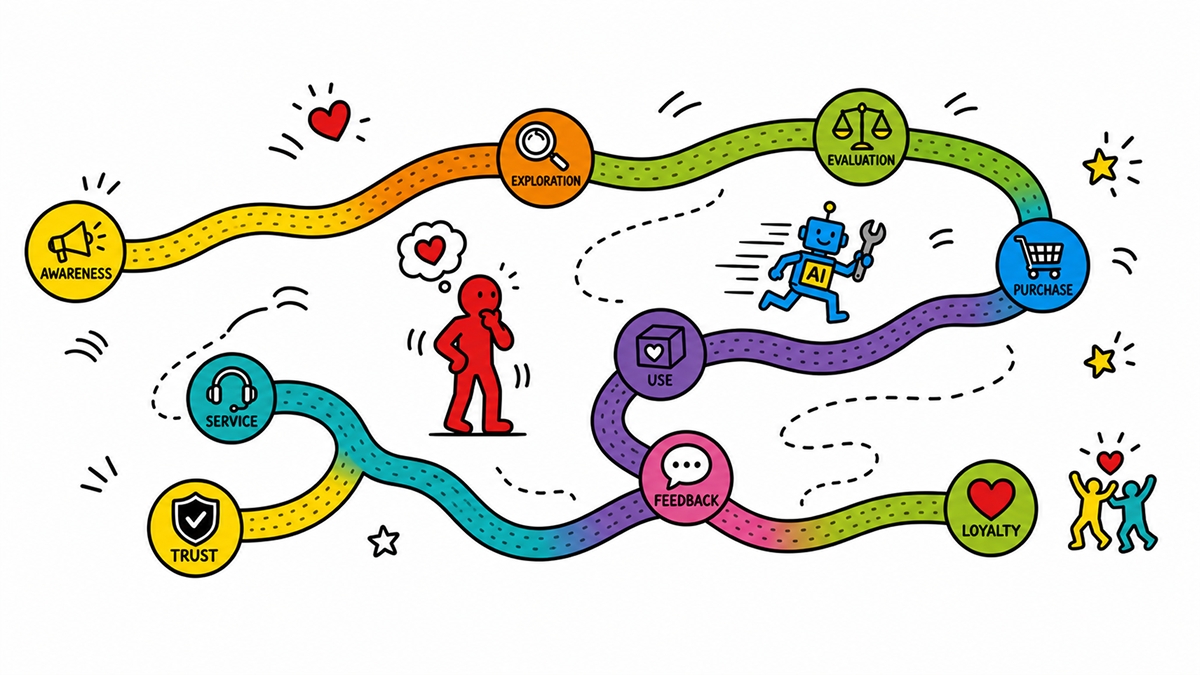
The important question is not whether a company should use AI. The real question is where, how, and to what extent AI should intervene within the Customer Experience Journey. In stages that involve repetitive or rational decision-making, AI can help customers stay in control and move through the process more easily. But in moments shaped by anxiety, trust, assurance, or responsibility, human explanation and emotional response may become central to the customer experience.
03
When AI intervention creates a break in the experience
Consider the journey of purchasing insurance. Direct-to-consumer insurance is designed so that customers can sign up easily and quickly through digital channels. For customers who are comfortable using digital services, this can be a convenient and efficient experience.
But not every customer experiences convenience in the same way. Customers with limited access to or comfort with digital channels, customers who want to hear detailed explanations before making a decision, or customers who feel reassured by human confirmation during an important contract process may find face-to-face consultation or access to a human advisor more appropriate.
The issue can also appear after the initial sign-up. In some insurance enrollment journeys, an AI-powered confirmation process may be used after enrollment to verify that the customer understood and agreed to the terms. This approach is not inherently wrong. For customers who completed the process independently through a digital channel, it may feel natural and efficient.
However, if a customer has signed up through an advisor or consultant after receiving human explanation, and is then suddenly moved into a standardized AI confirmation call at the final stage, the experience may feel disconnected. The relationship flow that had been built throughout the journey can be interrupted.
The customer has already made an important decision within a specific relationship context with the company. They have listened, asked questions, built trust, and reached the point of agreement through human interaction. At that final moment, AI intervention may not feel like simple automation. It may feel like a break in the experience.
The company may gain efficiency, but the customer may lose the feeling that they are being understood.
04
The role of AI should change according to the customer journey
In high-involvement journeys such as insurance enrollment, where decisions involve long-term spending and can have a direct impact on a person’s life, AI intervention should vary according to customer type, sign-up channel, level of understanding, and emotional uncertainty.
For customers who enroll independently through digital channels, an AI-based confirmation process may be appropriate. For customers who join through a human advisor or consultant, human confirmation or a choice of confirmation channels may feel more natural.
This is what experience strategy means when it is grounded in the flow of the customer journey.
AI will continue to become a more natural part of everyday life. Eventually, customers may no longer perceive AI as a special technology at all. But that kind of natural acceptance does not happen by placing AI randomly across every touchpoint.
For AI to become truly natural in customer experience, companies must distinguish between moments that require technology and moments that require people.
05
Before applying technology, companies need customer-centered experience strategy
I for customer experience does not mean faster automation. It means AI designed in a way that customers can understand, trust, and accept.
Companies need to diagnose where AI can support customer choice and where human explanation or emotional response can create greater trust.
AI fumbles the customer experience not because the technology itself is lacking. It happens when companies fail to design when AI should step in and when it should step back within the customer journey.
As technology advances faster than ever, companies do not simply need more AI implementation. They need experience strategy that can identify the moments where AI is truly needed by the customer.
AI should not be used as a showcase of a company’s technological capability. It should be designed within an experience structure that strengthens customer understanding, trust, and the relationship with the brand.
This is why Saltcake places importance on customer journey-based experience diagnosis. For AI to be naturally accepted within customer experience, companies must first understand when customers need help, and when they need trust, assurance, or human sensitivity.
Only AI designed on top of that diagnosis can become a better experience for customers and a source of sustainable business value for companies and brands.